<?xml version="1.0" encoding="utf-8" ?>
<rdf:RDF xmlns:rdf="http://www.w3.org/1999/02/22-rdf-syntax-ns#" xmlns:dc="http://purl.org/dc/elements/1.1/" xmlns:syn="http://purl.org/rss/1.0/modules/syndication/" xmlns="http://purl.org/rss/1.0/">


<channel rdf:about="http://lta.iwlearn.org/search_rss">
  <title>Lake Tanganyika</title>
  <link>http://lta.iwlearn.org</link>

  <description>
    
            These are the search results for the query, showing results 1 to 2.
        
  </description>


  <image rdf:resource="http://lta.iwlearn.org/logo.png"/>

  <items>
    <rdf:Seq>
      
        <rdf:li rdf:resource="http://lta.iwlearn.org/possible-effects-of-global-climate-change-on-the-ecosystem-of-lake-tanganyika"/>
      
      
        <rdf:li rdf:resource="http://lta.iwlearn.org/the-physics-of-the-warming-of-lake-tanganyika-by-climate-change"/>
      
    </rdf:Seq>
  </items>

</channel>


  <item rdf:about="http://lta.iwlearn.org/possible-effects-of-global-climate-change-on-the-ecosystem-of-lake-tanganyika">
    <title>Possible effects of global climate change on the ecosystem of Lake Tanganyika</title>
    <link>http://lta.iwlearn.org/possible-effects-of-global-climate-change-on-the-ecosystem-of-lake-tanganyika</link>
    <description>Any change in the air temperature, wind speed, precipitation, and incoming solar radiation induced by increasing greenhouse gasses and climate change will directly influence lakes and other water bodies. The effects of a slight increase in lake  water temperature on the Lake Tanganyika  ecosystem might be mitigated by increased windiness, if the latter was sufficient to induce greater mixing.</description>
    <content:encoded xmlns:content="http://purl.org/rss/1.0/modules/content/"><![CDATA[<p>Any change in the air temperature, wind speed, precipitation, and incoming solar radiation induced by increasing greenhouse gasses and climate change will directly influence lakes and other water bodies.</p>
<p>The influence can cause changes in the physical (water temperature, stratification, transparency), chemical (nutrient loading, oxygen) and biological (structure and functioning of the ecosystem) components of the <a name="hit3"></a><span>Lake</span>. In this work an influence of the likely effects of the climate change on the above three components of <a name="hit4"></a><span>Lake</span> <a name="hit5"></a><span>Tanganyika</span> are studied by means of a simple ecological model.</p>
<p>Simulations for the years 2002-2009 have been performed using the wind and solar radiation data from the National Centres for Environmental Protection (NCEP) reanalysis. Various possible climatic scenarios are studied by changing the surface layer depth, its temperature and the wind stress.</p>
<p>Any change in any of the above physical forcing parameters modifies the timing and intensity of the dry season peaks of the biogeochemical parameters. It is seen that the gross production increases as temperature of the surface layer increases and its depth decreases. High temperature and low wind stress, reduces the biomass.</p>
<p>The effects of a slight increase in <a name="hit6"></a><span>lake</span> water temperature on the <a name="hit7"></a><span>Lake</span> <a name="hit8"></a><span>Tanganyika</span> ecosystem might be mitigated by increased windiness, if the latter was sufficient to induce greater mixing.</p>
<table id="contentTable">
<tbody align="left">
<tr>
<td class="data_heading" style="text-align: left; " width="100"><b>Author:</b></td>
<td style="text-align: left; "> </td>
<td class="data_content" style="text-align: left; "><a>Naithani, Jaya</a>; <a>Plisnier, Pierre-Denis</a>; <a>Deleersnijder, Eric</a></td>
</tr>
</tbody>
</table>
<p style="text-align: left; "><strong>Source:</strong> Hydrobiologia [Hydrobiologia]. Vol. 671, no. 1, pp. 147-163. Aug 2011.</p>]]></content:encoded>
    <dc:publisher>No publisher</dc:publisher>
    <dc:creator>Alain Gashaka</dc:creator>
    <dc:rights></dc:rights>
    
      <dc:subject>Climatic changes</dc:subject>
    
    
      <dc:subject>Tanganyika L.</dc:subject>
    
    <dc:date>2012-08-02T22:00:00Z</dc:date>
    <dc:type>News Item</dc:type>
  </item>


  <item rdf:about="http://lta.iwlearn.org/the-physics-of-the-warming-of-lake-tanganyika-by-climate-change">
    <title>The physics of the warming of Lake Tanganyika by climate change</title>
    <link>http://lta.iwlearn.org/the-physics-of-the-warming-of-lake-tanganyika-by-climate-change</link>
    <description>Climate warming over the 20th century has increased the density stratification and stability of Lake Tanganyika, a deep rift valley lake. While lakes in general will increase heat outputs in a warming climate, heat outputs will increase more slowly in deeper lakes than in shallower lakes.</description>
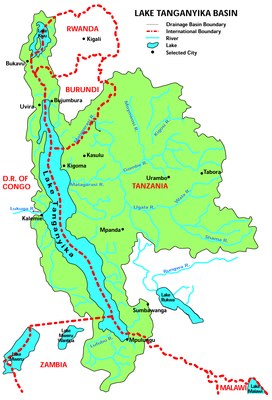
    <content:encoded xmlns:content="http://purl.org/rss/1.0/modules/content/"><![CDATA[<p><img src="http://lta.iwlearn.org/LakeTanganyikaMap.jpg/@@images/f10cf8e5-4839-411b-be22-22d029187328.jpeg" style="float: right; " title="Lake Tanganyika Map" class="image-inline" alt="Lake Tanganyika Map" />Climate warming over the 20th century has increased the density stratification and stability of Lake Tanganyika, a deep rift valley lake. Here we examine the physical processes involved in and affected by the warming of the lake, and we discuss effects on lake productivity.</p>
<p>The rate of net heat absorption by Lake Tanganyika has been 0.4 W m super (-2) since 1913, twice the rate in the global ocean, indicating stronger climate forcing in the East African region. Lakes warm through increased incoming long-wave radiation. While lakes in general will increase heat outputs in a warming climate, heat outputs will increase more slowly in deeper lakes than in shallower lakes. Temperatures have increased by 0.2 degree C at 1000 m in depth, in part because of reduced cool marginal inflows, while water surface temperatures have increased by about 1.3 degree C.</p>
<p>This differential heating over depth has increased the density gradient through the water column, reducing the potential for vertical mixing and thereby limiting nutrient fluxes to the phototrophic zone. An increase in transparency, indicating a reduction in productivity as a result of the reduced vertical mixing, occurred both in Lake Tanganyika and in Lake Malawi, a similar deep tropical lake in which warming has also been documented.</p>
<p><strong>Source : Limnology and Oceanography [Limnol. Oceanogr.]. Vol. 54, no. 6, pp. 2418-2430. 2009.</strong></p>]]></content:encoded>
    <dc:publisher>No publisher</dc:publisher>
    <dc:creator>Alain Gashaka</dc:creator>
    <dc:rights></dc:rights>
    
      <dc:subject>Africa</dc:subject>
    
    
      <dc:subject>Climatic changes</dc:subject>
    
    
      <dc:subject>Density gradients</dc:subject>
    
    
      <dc:subject>Density stratification</dc:subject>
    
    
      <dc:subject>Limiting factors</dc:subject>
    
    
      <dc:subject>Nyasa L.</dc:subject>
    
    
      <dc:subject>Rift valleys</dc:subject>
    
    
      <dc:subject>Tanganyika L.</dc:subject>
    
    
      <dc:subject>Transparency</dc:subject>
    
    
      <dc:subject>Tropical lakes</dc:subject>
    
    
      <dc:subject>Vertical mixing</dc:subject>
    
    <dc:date>2012-04-12T22:00:00Z</dc:date>
    <dc:type>News Item</dc:type>
  </item>


</rdf:RDF>
